

T-Mobile SpaceX Starlink usage has gone from beta curiosity to mainstream service in under a year. If you’ve ever pulled out your phone in the middle of nowhere and seen the words “T-Mobile SpaceX” or “T-Sat+Starlink” at the top of your screen, that little indicator is the live Direct-to-Cell service running on more than 650 specially configured Starlink satellites in low Earth orbit.
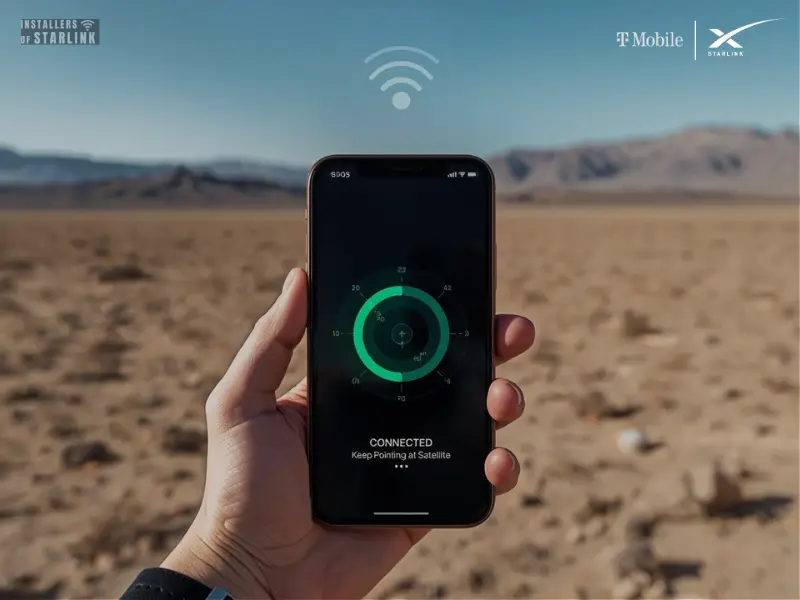
As of May 2026, that constellation covers over 500,000 square miles of U.S. territory that traditional cell towers do not reach — roughly the size of two Texases. You can confirm coverage on T-Mobile’s official T-Satellite page.
But there’s a real gap between what people think T-Mobile Starlink can do and what it actually does today. We get the same handful of questions from customers in rural Wyoming, Tennessee hill country, the Texas Panhandle, and northern Maine on nearly every install. So this is a clear, no-fluff breakdown of T-Mobile SpaceX Starlink usage in 2026 — what works, what doesn’t, where it reaches, what it costs, and where a stationary Starlink Kit still beats it.
For the business product (SuperBroadband, the dual-path 5G + Starlink service), see our companion post: T-Mobile Starlink Business Internet: SuperBroadband Explained.
What "T-Mobile SpaceX" actually is on your phone
T-Satellite is the consumer-facing name. “T-Mobile SpaceX” and “T-Sat+Starlink” are the network identifiers your phone displays when it’s connected. All three refer to the same thing: a direct-to-cell satellite service that uses SpaceX‘s specially configured satellites as cell towers in space.
Here’s the part most articles skip — and we say this because it’s the single most common point of confusion when our installers are on a customer’s roof and the homeowner asks about it: you don’t activate it manually. As soon as your phone loses traditional cellular and roaming coverage, a compatible device automatically searches for and connects to the satellite network. You’ll see one of these indicators:
- Apple iPhone: signal bars, the letters “SAT,” and the network name “T-Mobile SpaceX” or “T-Sat+Starlink”
- Android: a small satellite icon in the status bar, plus the same network name
- Both: messages may take longer to send than over LTE — that’s normal, not a fault
Manually selecting the satellite network in settings won’t work if any cellular signal is available. The system is designed to fall back to satellite only when there’s no other option, which keeps your battery from burning through trying to reach orbit when a tower 4 miles away would do.

What T-Mobile SpaceX Starlink usage covers in 2026
This is the question we get most often from rural customers: what can I actually do with it? Here’s the honest list as of right now.
What works today
- SMS and MMS texting — including picture messages, the feature that finally launched after months of beta limits
- Text-to-911 — your location is shared automatically with the operator, and the service works even if you’re not a T-Mobile customer
- Wireless Emergency Alerts (WEAs) — broadcast nationwide via FCC protocols, including to anyone in range during severe weather or natural disasters
- Location sharing — through native apps and most messaging platforms
- Select satellite-optimized apps — the data side of the service, expanded steadily since launch.
Apps that currently work over T-Mobile SpaceX Starlink
The short list of apps confirmed working over T-Mobile SpaceX Starlink usage as of spring 2026, based on T-Mobile’s published optimized-app list and our own field observations during installs in dead-zone areas:
- iMessage and Google Messages for texting and photos
- WhatsApp — including voice messages and video messages
- Google Maps for navigation and location
- AllTrails for hiking and offline trail data
- AccuWeather for forecasts and severe-weather alerts
- X (formerly Twitter) for posting and reading
- T-Mobile’s T-Life app for account management
T-Mobile and SpaceX continue to add optimized apps as the constellation grows. Apps not on the optimized list may still partially work, but performance varies — and it’s worth noting that we regularly see customers assume an app will work because they’ve heard “Starlink data is live now,” only to find their banking app or video service doesn’t.
What doesn’t work yet
Be realistic about the limits. Today’s T-Mobile SpaceX Starlink usage does not include:
- Standard voice calls (coming with the V2 constellation)
- Full app data the way LTE delivers it
- Streaming video, music, or large file downloads
- Indoor coverage — your phone needs a clear view of the sky
- Reliable service under heavy tree canopy or in deep canyons
Voice calls and broader data are on the roadmap. SpaceX is targeting mid-2027 to begin launching V2 Direct-to-Cell satellites on Starship, with phased-array antennas and custom chips the company says will deliver up to 100x more data density than V1. The goal is roughly 1,200 V2 satellites in orbit within six months of launch start, enough to support 5G-class speeds from space.
What we don’t know yet: the V2 timeline depends entirely on Starship reaching reliable launch cadence with payload deployment, which has been improving but is not a sure thing. Plan around the V1 capabilities you have today, not the V2 capabilities you might get in late 2027. (More technical detail on V1 vs. V2 is available in SpaceX’s official Direct to Cell overview.)
Where T-Mobile SpaceX Starlink usage actually reaches
Coverage is one of the strongest parts of T-Mobile SpaceX Starlink usage, and the boundaries are worth knowing.
- Continental U.S. — including most national forests, BLM land, and rural areas without tower coverage
- Hawaii
- Puerto Rico
- Parts of southern Alaska
- Canada and New Zealand — through international roaming partnerships
- More countries on the way — reciprocal agreements signed with KDDI (Japan), Telstra and Optus (Australia), One NZ, Salt (Switzerland), Entel (Chile and Peru), Rogers (Canada), and Kyivstar (Ukraine)
What you need at every location: a clear view of the sky. Satellite radios cannot punch through a roof, a dense forest canopy, or the inside of a vehicle in a parking garage. We see this firsthand on installs — the same canopy that obstructs a Starlink dish at 25 feet of mounting height will also kill a phone-side satellite signal at ground level. If you can step outside and see open sky, you can almost always get a connection.
How much T-Mobile SpaceX Starlink usage costs
Pricing for T-Mobile SpaceX Starlink usage has stayed simple since launch:
- $10 per month as an add-on for most T-Mobile plans
- Included free with T-Mobile’s Experience Beyond plan and select premium plans like Go5G Next
- Available to AT&T and Verizon customers — yes, you can add T-Satellite without switching carriers, for the same $10 per month
- Free Text-to-911 by satellite — available to anyone with a compatible phone, regardless of carrier or plan
That last point is worth repeating. Even if you never sign up, if your phone is compatible and you’re in a satellite coverage area, you can text 911 in an emergency. That alone has changed the calculation for hikers, hunters, ranchers, and anyone who spends meaningful time outside cell range — including the kind of customers we install for every week.
Compatible phones in 2026
Phones that support T-Mobile SpaceX Starlink usage cover most devices from the last four years, spanning a wide swath of the iPhone and Android lineup. T-Mobile maintains the official compatibility list — check before you sign up if you’re holding onto an older device. New phones released through 2026 are increasingly being optimized for satellite from the factory, and based on what customers show us during install walkthroughs, the most common in-the-wild devices we see connecting to T-Mobile SpaceX are iPhone 14 and newer and Galaxy S22 and newer.
How T-Mobile SpaceX Starlink usage compares to regular cell service
Honest side-by-side, since this is where customers either become happy or disappointed. For each capability, here’s what you get on regular LTE/5G versus what you get on T-Mobile SpaceX Starlink usage today (V1):
- Texting: instant over LTE/5G; instant to a few seconds delayed over satellite
- Picture messages: instant over LTE/5G; slower but supported over satellite
- Voice calls: standard on LTE/5G; not yet on satellite (coming with V2 in mid-2027)
- Video streaming: works fine on LTE/5G; not supported over satellite
- Navigation: full functionality on LTE/5G; optimized apps only over satellite
- Indoor performance: works on LTE/5G; not at all over satellite — you need a clear view of the sky
- Coverage: wherever towers reach on LTE/5G; over 500,000 sq mi of additional dead zones over satellite
- Cost: plan-dependent on LTE/5G; $10/mo add-on or included on premium T-Mobile plans for satellite
T-Satellite is not a replacement for cellular. It’s a safety net and a “hey, I’m running late” tool for the parts of the country where cellular has never existed. Used with that expectation, T-Mobile SpaceX Starlink usage is outstanding.
Real-world T-Mobile SpaceX Starlink usage scenarios
A few of the situations where customers have told us T-Mobile SpaceX Starlink usage paid for itself within the first month — drawn directly from conversations during installs across our 50-state coverage area:
- Rural property owners who lose tower signal at the end of the driveway and can now text family from the back forty — a recurring conversation on installs in places like the Texas Hill Country, central Wyoming, and the Appalachians
- Long-haul drivers and RVers crossing western states where carrier maps have honest dead zones for hundreds of miles. Tour bus and sprinter van customers we install for routinely lean on T-Satellite as the personal-phone layer while the on-board Starlink Kit handles vehicle Wi-Fi
- Hikers and hunters in national forests where Garmin inReach used to be the only option
- Ranchers and farmers working out of cell range during planting and harvest — particularly in parts of Montana and the Dakotas where tower density has barely changed in a decade
- Disaster recovery when a hurricane, wildfire, or ice storm takes a regional tower offline and Starlink keeps texts flowing
- Cabins and remote second homes as a bridge until a permanent Starlink Kit is installed
That last one is where our work overlaps directly with T-Mobile SpaceX Starlink usage.
Where a Starlink Kit still beats T-Satellite for everyday use
This is the part to be clear about: T-Mobile SpaceX Starlink usage is a phone service, not a home internet replacement. It connects a single device, in your hand, with limited data and no voice (yet).
If you live, work, or run a business in a low-coverage area, a stationary Starlink Kit on the roof gives you:
- Full broadband speeds — typical residential users see 100–250+ Mbps downloads
- Wi-Fi for every device in the home — not one phone outdoors
- Streaming, video calls, gaming, smart-home devices — all the things T-Satellite explicitly cannot do
- Reliable 24/7 connectivity — not dependent on stepping outside with your phone.
That’s where we come in. Installers of Starlink is a nationwide professional installation service for residential, commercial, mobile, and marine Starlink kits. Our technicians have completed over 3,000 installations across all 50 states, with a typical scheduling window of 72 hours and an installation completed in 3 hours or less. If your T-Mobile SpaceX Starlink usage is great for the trail but you also want fiber-like internet at the house, a Starlink Kit is the answer — and a properly mounted one is the difference between a connection that works for a year and one that works for a decade.
For more on what we check before mounting a system, read How to Prepare Your Roof for a Starlink Installation (And What We Check) and Starlink in Rural Areas – What to Expect and How We Make It Reliable.
FAQ on T-Mobile SpaceX Starlink Usage
Bottom Line on T-Mobile SpaceX Starlink Usage in 2026
If you spend any meaningful time outside reliable cell coverage, T-Mobile SpaceX Starlink usage is a genuine upgrade over what was available even 18 months ago. It works automatically, costs $10 a month or comes free on premium plans, covers more than half a million square miles of dead zone, and saves lives through Text-to-911 even for people who never pay a dime.
Just don’t mistake it for a home internet plan. For everything beyond a phone in your pocket — a house, a shop, an RV park, a job site, a marine vessel — a properly installed Starlink Kit is still the right tool.
If you’re ready to get that part handled, our certified, insured technicians install nationwide with an average 5-minute response time to inquiries and a 1-year workmanship warranty.
Call (877) 309-1050, fill out a free quote form, or jump on live chat. We’re available Monday–Friday, 6:00 AM – 11:00 PM, and weekends 6:00 AM – 9:00 PM.
Related reading:
Connectivity News & Updates

Starlink for Businesses and Multi-Building Properties – Campus & Chain Solutions
In the modern commercial landscape, connectivity isn’t just an amenity—it’s...

T-Mobile SpaceX Starlink Usage: What T-Satellite Actually Lets You Do in 2026
T-Mobile SpaceX Starlink usage has gone from beta curiosity to...
T-Mobile Starlink Business Internet: SuperBroadband Explained
T-Mobile Starlink business internet officially became a real product on...

Starlink in Rural Areas – What to Expect and How We Make It Reliable
For decades, living in the country meant making a difficult...