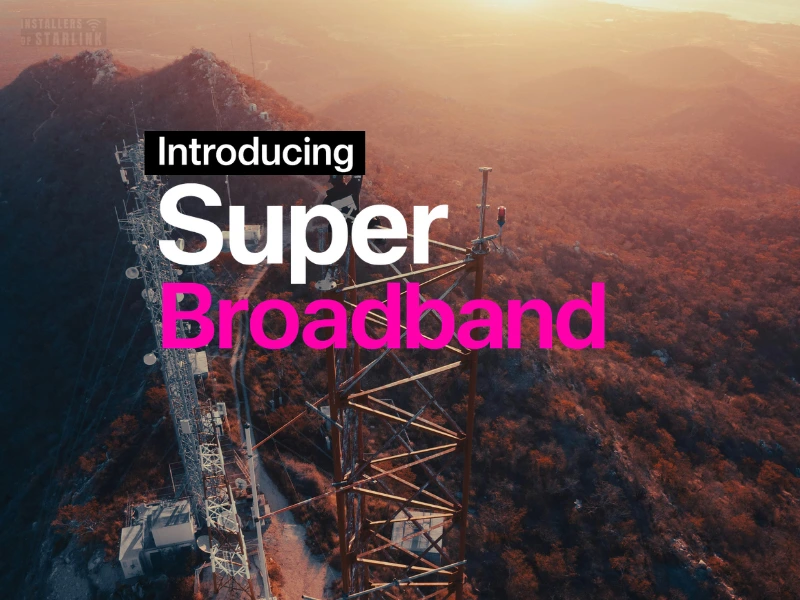
T-Mobile Starlink business internet officially became a real product on April 28, 2026, when T-Mobile and SpaceX launched SuperBroadband — a fully managed service that pairs T-Mobile’s 5G network with Starlink’s satellite constellation under one contract, one bill, and a financially backed 99.99% uptime guarantee.
If you’ve been searching for T-Mobile Starlink business internet this week, this is the product you’re hearing about. Below is a clear, no-fluff breakdown of what SuperBroadband is, what it costs, what’s included, and whether it makes sense for your business. (And if you’re looking for the handset-side product instead, see our T-Satellite Explained guide for businesses.)
What SuperBroadband actually is
SuperBroadband is the first nationwide T-Mobile Starlink business internet service to combine two completely independent connectivity pathways at every business location:
- T-Mobile 5G as the primary connection
- Starlink low-Earth orbit satellites as the parallel backup
Traffic flows across both paths simultaneously. If one fails — fiber cut, tower outage, storm damage — the other keeps your business online. T-Mobile is positioning this dual-path architecture as the answer to the patchwork of regional ISPs, separate failover services, and incompatible hardware most multi-location businesses end up stitching together.
The result is a single managed product that reaches every ZIP code in the United States, with one provider, one support team, and one bill.
The 99.99% uptime guarantee
This is the headline number, and unlike most marketing promises, this one comes with real money behind it:
- The guarantee applies in areas with both T-Mobile 5G and Starlink coverage
- A “qualifying outage” is a single continuous service loss of at least about 4.3 minutes at the location
- One credit per month, equal to 20% of base monthly service cost, available if you notify T-Mobile within 14 days
- Excludes planned maintenance, on-site power outages, customer-initiated configuration changes, and brief 5G/Starlink switching time
For businesses where downtime translates directly to lost revenue — point-of-sale systems, telehealth visits, scheduling platforms, video calls — having a contractual remedy is a meaningful upgrade over the “best effort” service most ISPs offer.
T-Mobile Starlink business internet pricing
Pricing for T-Mobile Starlink business internet starts at $250 per month, plus a $35 device connection charge, on a 36-month commitment. The starting price includes:
- Unlimited business 5G data, with prioritized “slice” data on the first 100 GB per month
- Unlimited backup Starlink data
- Enterprise-grade 5G equipment
- The Starlink Kit at the location
- Professional installation
- Ongoing network monitoring through T-Mobile’s T-Platform
There are three tiers — Standard, Enhanced, and Advanced. Higher tiers add outdoor 5G equipment for stronger signal capture, advanced routing, and a higher-performance Starlink kit. Final pricing depends on the specific deployment.
A few cost details worth knowing:
- Soft data cap. Locations using more than 1.2 TB per month may experience further speed reductions during congestion.
- 5G overage. Once the prioritized 100 GB is used, additional traffic comes in 100 GB blocks at extra cost.
- Multi-site pooling. Across multiple locations, data allotments are pooled — useful for retail chains where some stores run heavier than others.
- Early termination. Canceling before 36 months means paying out the remainder.
The hardware behind the service
T-Mobile didn’t build this on consumer-grade gear:
- Ericsson Cradlepoint routers as the primary networking platform
- Outdoor 5G adapters for stronger signal capture
- Inseego joining as an additional ecosystem partner
- The Starlink Kit for the satellite path
- Ericsson NetCloud Manager for centralized control across locations
- T-Platform for visibility into network performance, hardware status, usage, and failover activity
Installation runs through Acuative, T-Mobile’s nationwide field services partner. Single-location and multi-thousand-location deployments use the same managed model.
Who SuperBroadband is for
T-Mobile has been explicit about target sectors. Early customers include Aramark Destinations and Columbia Sportswear — and Columbia’s operations team has noted that a single downed checkout lane at a top-25 store can cost roughly $10,000 per hour. That’s the math driving this product.
The clearest fits for T-Mobile Starlink business internet:
- Multi-site retail and restaurants where every minute of POS downtime is measurable revenue loss
- Healthcare including clinics, urgent care, and mobile health units
- Hospitality where guest Wi-Fi and booking systems define the customer experience
- Energy, oil and gas, and agriculture at sites traditional ISPs don’t reach
- Construction for job-site trailers and project locations
- Logistics and warehousing with locations across regions where local providers vary wildly
SuperBroadband vs. T-Satellite
T-Mobile actually has two Starlink-powered products for business, and the names sound similar enough that people mix them up.
T-Satellite with Starlink is the handset-side product. It connects the smartphones already in your employees’ pockets, so there’s no hardware to buy or deploy — the phones they’re using today simply pick up satellite service when terrestrial coverage drops out. Pricing runs $10 per month per line, or it’s included free with T-Mobile’s Experience Beyond for Business plans. There’s no formal SLA attached; it’s a best-effort service designed to keep mobile workers reachable in dead zones.
SuperBroadband is the building-side product. Instead of phones, it connects fixed business sites — stores, clinics, warehouses, branch offices — using a Starlink Kit and an Ericsson Cradlepoint 5G router installed on premises. Pricing starts at $250 per month plus a $35 device connection fee, on a 36-month commitment. Unlike T-Satellite, SuperBroadband comes with a financially backed 99.99% uptime guarantee, including service credits when the contract isn’t met.
Most companies with both a building footprint and a mobile workforce will want both. SuperBroadband keeps the building online. T-Satellite keeps employees reachable when they walk away from the building. For a deeper look at the phone-side product, read our companion post on T-Satellite for business.
The fine print before you sign
A 36-month commitment is real. Walk through these before you sign:
- Site survey at every location. Confirm clear sky view for the Starlink dish — trees, parapets, neighboring buildings, and HVAC equipment all matter.
- Bandwidth profile. Pull six months of usage data per location. If you’re consistently over 1.2 TB per month at any site, model the soft cap impact.
- Tier selection. Standard might cover a small clinic; an oil-and-gas yard or busy retail flagship probably needs Enhanced or Advanced.
- Existing infrastructure. If you have fiber at some sites, confirm how 5G and Starlink integrate with what you already have.
- Multi-site standards. For larger rollouts, lock in install standards up front.
Where a Starlink installer fits in
T-Mobile uses Acuative for the standard install. There are still real situations where bringing in an experienced Starlink installer pays off:
- Pre-contract site surveys. Confirm every location can deliver before you commit to 36 months.
- Specialty mounts. Marine vessels, food trucks, mobile clinics, RVs, disaster-recovery sites, and complex commercial roofs.
- Customer-facing locations. Retail flagships and hotels that need cleaner cosmetic installs — concealed cable runs, paint-matched conduit.
- Independent Starlink Business installs. Businesses that don’t want a SuperBroadband contract but still want Starlink at one or more locations with their own cellular failover.
- Multi-site consistency. When you’re rolling out to 20, 50, or 200 locations, a partner who delivers the same standard everywhere matters.
Should your business adopt T-Mobile Starlink business internet?
If your business is single-location, downtown, with reliable fiber and no rural exposure — probably not. The $250+ per month entry price is overkill.
If your business is multi-site, has any locations where wired broadband is unreliable, sees real revenue impact from downtime, or operates in any of the 500,000+ square miles of the U.S. that traditional networks struggle to cover — SuperBroadband is the most credible T-Mobile Starlink business internet option on the market today. The uptime guarantee is genuinely backed. The hardware is enterprise-grade. The single-bill model removes a real source of operational pain.
The 36-month commitment is the trade-off. It’s worth taking only if you’ve confirmed every location can actually deliver what the contract promises.
Related reading:
- T-Mobile Starlink Business Internet: T-Satellite Explained (2026) — the companion piece on T-Mobile’s satellite phone service for businesses.
Connectivity News & Updates
T-Mobile Starlink Business Internet: SuperBroadband Explained
T-Mobile Starlink business internet officially became a real product on...
Starlink in Rural Areas – What to Expect and How We Make It Reliable
For decades, living in the country meant making a difficult...
Common Starlink Installation Mistakes (And How Our Technicians Avoid Them)
When you receive your Starlink kit, the “plug-and-play” marketing makes...
How to Prepare Your Roof for a Starlink Installation (And What We Check)
Wondering how to prepare your roof for a Starlink installation?...
