How Big is a Starlink Satellite

Starlink satellites keep getting bigger because demand keeps growing. Today’s most common spacecraft is the V2 Mini. It weighs about 800 kg (1,760 lbs) at launch. Its body spans a little over 4.1 meters (13.5 ft) across when stowed. That width supports larger phased arrays and more power. Consequently, each unit can deliver more bandwidth to the ground. Earlier generations ran smaller and lighter. Those craft helped SpaceX scale coverage fast. However, they carried less capacity per satellite than today’s models.

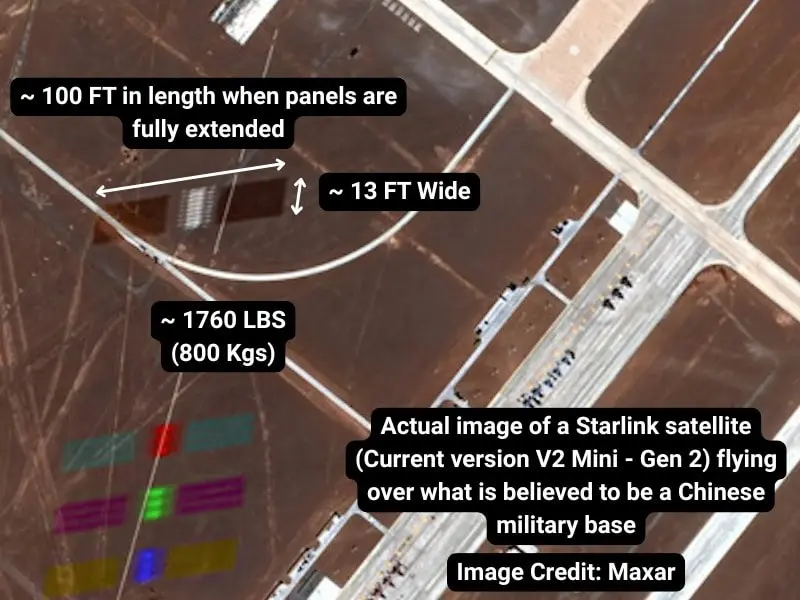
Annotated image of a Starlink V2 Mini over a suspected Chinese military base, showing ~100 ft wingspan, ~13 ft body width, ~1,760 lbs (800 kg)—answering the question “How big is a Starlink satellite?”

Size changes for three reasons. First, launch vehicle limits shape the stowed envelope. Falcon 9 constrained early designs. Second, radio performance improves with bigger antennas and more power. Third, manufacturing cadence rewards designs that pack and deploy efficiently. Therefore, engineers adjust mass and dimensions with each step. You see that evolution in the move from v1.x to V2 Mini. You will likely see another jump with the full-size V2.

So how big is a Starlink satellite right now? Use this simple summary. A V2 Mini weighs 800 kg (1,760 lbs). Its body is over 4.1 meters (13.5 ft) wide. When deployed, its twin solar wings span about 30 meters (100 ft). Meanwhile, an older v1.5 weighs 260–306 kg (570–675 lbs). Finally, a future full-size V2 targets about 1,250 kg (2,760 lbs). It measures roughly 7 m × 3.5 m (23 ft × 11.5 ft). These figures let you compare eras without guesswork.

Generations at a glance: mass and dimensions that actually help

Understanding “How Big is a Starlink Satellite?” starts with generations. SpaceX shipped several configurations since 2019. Each step balanced launcher volume, manufacturing speed, and network goals. As a result, both mass and size shifted in useful ways. Let’s map the highlights with clear, human-friendly numbers.

Starlink v1.0 established the flat-panel approach. Units weighed about 260 kg (570 lbs). The compact bus stacked densely inside Falcon 9. That density let SpaceX deploy up to 60 per mission. Therefore, coverage expanded rapidly during early rollouts. The tradeoff involved per-satellite capacity and power headroom.

Starlink v1.5 added laser inter-satellite links and refinements. Mass rose into the 260–306 kg (570–675 lbs) range. External footprint stayed similar to v1.0. Thus, Falcon 9 could still carry large batches. The big win came from better backhaul and routing flexibility.

Starlink V2 Mini marked a major jump for Gen2 shells. Launch mass reached ~800 kg (1,760 lbs). The body grew to >4.1 m (13.5 ft) in width. Deployed solar arrays expanded to ~30 m (100 ft) tip to tip. Therefore, each craft supports larger phased arrays and higher throughput. Falcon 9 remained the launcher, which kept cadence high.

Full-size V2 (Starship-class) goes bigger again. Public targets point to ~1,250 kg (2,760 lbs). Dimensions land near 7 m × 3.5 m (23 ft × 11.5 ft) in stowed form. That scale aims at direct-to-cell support and greater capacity. Crucially, Starship’s fairing unlocks this envelope. Consequently, engineers can prioritize performance over tight packing.

Starlink Satellite Size in FT and Pounds (quick conversions + context)

Many readers search “Starlink satellite size in FT and pounds.” This section gives plain numbers and useful context. You will also see how stowed dimensions differ from deployed spans. That difference matters because the arrays swing out after orbit insertion.

Current v1.5 and V2 Mini

  • Weight: v1.5 runs 260–306 kg (570–675 lbs). V2 Mini weighs ~800 kg (1,760 lbs).

  • Body size (stowed): V2 Mini’s bus is >4.1 meters (13.5 ft) wide. Length varies by configuration, yet the width drives fairing fit.

  • Deployed wingspan: V2 Mini’s two solar wings reach ~30 meters (100 ft). That span increases available power for radios and crosslinks.

Future full-size V2 (Starship-class)

  • Weight: about 1,250 kg (2,760 lbs).

  • Stowed dimensions: approximately 7 m × 3.5 m (23 ft × 11.5 ft).

  • Deployed footprint: final deployed span will exceed the bus. The arrays will grow the visual width substantially.

Remember this useful pattern. Stowed dimensions determine how many satellites a rocket can carry. Deployed dimensions determine how much power and thermal area a satellite gains in orbit. Therefore, a small stowed body can still unfold into a very wide solar array. That is why the V2 Mini looks “car-wide” in the fairing, yet “billboard-wide” in space.

For mental scale, compare weights to common items when trying to envion “how big is a Starlink satellite?”. A v1.5 unit equals a large home appliance stack. A V2 Mini equals a small SUV without passengers. Meanwhile, a full-size V2 nears a compact car’s curb weight. These comparisons help you visualize mass while avoiding technical jargon.

Why dimensions grew: power, antennas, and the launcher envelope

Starlink satellite size does not increase for style points. Engineers push dimensions when the payoff justifies the mass. Three drivers explain the Starlink growth curve. Together, they outline why “How Big is a Starlink Satellite?” keeps changing.

Power first. Phased arrays and laser links need steady power. Larger solar wings and radiators help meet that need. Consequently, V2 Mini expanded its wingspan to ~30 meters (100 ft). That area supports higher duty cycles during busy hours. More power also aids onboard processing and crosslink uptime.

Antennas next. Bigger apertures support tighter beams and higher spectral efficiency. As arrays grow, link budgets improve at the cell edge. Therefore, the network can serve more users per craft. You feel that as higher peak rates and fewer slowdowns.

Launcher limits last. Falcon 9’s fairing sets strict width rules. Early generations stayed narrow to maximize stacks. V2 Mini presses close to that width while keeping stacks viable. The full-size V2 breaks free by riding Starship. Starship’s larger fairing lets the bus grow to ~7 m × 3.5 m (23 ft × 11.5 ft). That shift reduces packing constraints and favors performance.

Additionally, designers consider brightness and debris. Lower altitudes and controlled reentry help reduce debris risk. Coatings and attitude tweaks help reduce reflected light. Consequently, later designs aim to balance performance and sky friendliness. You gain capacity while astronomers gain mitigation.

See the scale: practical comparisons you will actually remember

Numbers work best when paired with familiar objects. So let’s anchor the sizes with everyday things. You will keep these comparisons in mind long after reading.

Start with v1.5. At 260–306 kg (570–675 lbs), it mirrors two adults plus heavy luggage. Picture a compact dining table for the stowed footprint. Falcon 9 could carry many in one go. Therefore, SpaceX built coverage quickly and cost-effectively.

Now jump to V2 Mini. At ~800 kg (1,760 lbs), think of a small SUV. The stowed body is >13.5 ft wide. That equals the length of a compact hatchback. However, thickness stays far less than a car hood. Consequently, engineers still stack many inside the fairing. After deployment, the wings stretch to ~100 ft. Imagine a line of rooftop solar panels end-to-end. That span delivers the power gains users notice during peak hours.

Finally, look ahead to the full-size V2. At ~1,250 kg (2,760 lbs), think compact car mass. The bus targets ~23 ft by ~11.5 ft in the fairing. With Starship, volume concerns relax dramatically. Therefore, antennas and thermal hardware can scale further. That scale should support direct-to-cell features and more throughput. In practice, you should expect faster service and stronger rural resilience.

These images add meaning to the numbers. They also show why size links directly to experience. Bigger buses power bigger arrays and radios. Consequently, you see higher capacity without adding towers on the ground.

What to expect in 2025 and beyond

The constellation will not freeze at today’s dimensions. Instead, you should expect gradual, continuous iteration. SpaceX will keep launching V2 Mini on Falcon 9. Cadence remains strong, which helps coverage and refresh cycles. Meanwhile, Starship unlocks the full-size V2 envelope. When routine payload flights begin, the network can mix sizes by need. Therefore, specific orbits may receive larger craft for added capacity.

Two themes will drive the next updates. First, direct-to-cell support favors larger antennas and more power. Second, gateway and crosslink upgrades favor better thermal control. Both themes reward a bus closer to ~7 m × 3.5 m (23 ft × 11.5 ft). Mass around ~1,250 kg (2,760 lbs) supports those systems and reserves. Because Starlink refreshes hardware frequently, timelines will remain fluid. However, the direction is clear: more capability per satellite.

Keep one final idea in mind. Stowed size shapes launch economics. Deployed size shapes power and link budgets. As rockets evolve, designers can focus more on performance. Consequently, “How Big is a Starlink Satellite?” will keep changing. Use the FT and pounds numbers above for quick, confident comparisons. Then watch for updates as new buses reach operational cadence.

HOME | BLOG | LOCATIONS

Connectivity News & Updates

A detailed article comparing ASTS against Starlink.

ASTS vs Starlink

When people hear “satellite internet,” they often assume all space-based...