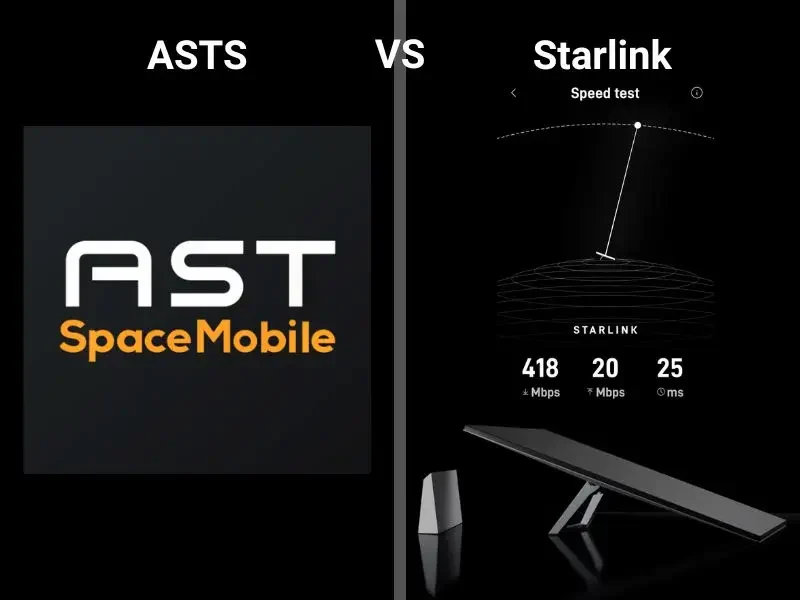
When people hear “satellite internet,” they often assume all space-based networks do the same thing. In reality, AST SpaceMobile (ASTS) and Starlink were built for very different purposes – differences that are in key in determining who the winner is when it comes to ASTS vs Starlink. While both use low-Earth orbit satellites, their architectures, goals, and real-world usefulness are not comparable. One is designed to extend cell coverage to smartphones.
The other is designed to replace traditional internet service entirely. Understanding this distinction is the key to seeing why Starlink is the clear winner for most users.
Below, we’ll break down what each system is actually built to do, how that affects performance, and why Starlink is the better choice for home, business, mobile, and marine internet needs.
ASTS vs Starlink: Two Very Different Missions
At a high level, AST SpaceMobile is trying to turn satellites into orbiting cell towers. Its goal is to connect regular smartphones directly to satellites using existing cellular spectrum. In other words, it is designed to fill in coverage gaps where cell towers don’t exist. This is extremely useful for emergencies, rural roads, remote hiking areas, and developing regions where building towers is impractical. However, it is not designed to be a high-capacity broadband service.
SpaceX’s Starlink, by contrast, was built from day one to be a full internet service provider. It uses dedicated user terminals (dishes) and Wi-Fi routers to deliver broadband connectivity to homes, businesses, vehicles, and vessels. Rather than extending cellular networks, Starlink bypasses them entirely. This allows it to offer much higher data rates, lower latency, and more consistent performance.
Because of this fundamental design difference, ASTS focuses on basic connectivity for phones, while Starlink focuses on high-throughput data for multiple devices at once. One is about coverage. The other is about capacity. That single distinction explains nearly every performance and usability difference between the two systems.
Why ASTS Falls Short for Home, Business, Mobile, and Marine Use
While ASTS is innovative, it is not well suited to be a primary internet solution. Homes and businesses need always-on connectivity that can support streaming, video calls, cloud applications, security systems, and multiple users simultaneously. ASTS is designed for direct-to-phone communication, not for running a household or office network. Even in its own rollout plans, coverage is expected to be limited and intermittent in the early phases, which makes it unreliable as a primary connection.
For mobile users, ASTS works best as a safety net. It ensures your phone can connect in places where it normally would not. However, it is not designed to replace mobile hotspots, routers, or in-vehicle internet systems. The bandwidth and consistency required for remote work, navigation systems, and connected vehicles simply aren’t its focus.
Marine use presents even more challenges. Boats and ships require stable links, higher power budgets, and hardware designed to track satellites while in motion. ASTS does not provide specialized marine terminals or dedicated maritime service plans. As a result, it is poorly positioned to serve as the main connectivity solution on the water.
In short, ASTS is excellent for filling coverage gaps, but it is not built to be a dependable, high-performance internet service for demanding environments.
Why Starlink Is the Clear Winner for Real-World Internet Needs
Starlink excels because it is purpose-built for high-capacity, real-world usage. It provides dedicated hardware, consistent performance, and service plans tailored to specific needs. For homes, it can replace cable, DSL, and even fiber in remote areas. Users can stream, game, work from home, and run smart devices without worrying about coverage gaps or unstable links.
For businesses, Starlink offers higher-priority tiers, better performance under load, and the reliability needed for daily operations. It is increasingly used as either a primary connection or a failover link for critical systems. This flexibility is something ASTS simply does not offer.
In mobile and travel scenarios, Starlink’s portable and in-motion solutions allow RVs, overlanders, and remote workers to stay connected while moving. The system is designed to handle handoffs between satellites seamlessly, maintaining usable speeds even in isolated areas.
Marine users benefit the most from Starlink’s design. With dedicated maritime hardware and global ocean coverage, vessels can maintain reliable connectivity far from shore. This supports navigation, operations, crew welfare, and emergency communications in ways that traditional satellite systems struggled to deliver.
Starlink doesn’t just promise connectivity. It delivers usable, high-speed internet where other options fail.
Final Verdict: Coverage vs Capability
When comparing ASTS vs Starlink, the real question is not which is “better” in theory, but which is better for actual users. ASTS is a coverage solution. It shines when your phone has no signal and you need basic connectivity. It is a powerful supplement to existing cellular networks and a potential lifesaver in emergencies.
Starlink, however, is a capability solution. It is designed to be your internet connection, not just a backup. Whether you are at home in a rural area, running a business, traveling off-grid, or crossing open water, Starlink is built to handle real workloads, real devices, and real demands.
That is why, for home, business, mobile, and marine use, Starlink is the clear winner. ASTS fills gaps. Starlink replaces infrastructure. For most people and most use cases, that difference is decisive.
If you’re choosing between the two, the simple rule is this:
If you want your phone to work in dead zones, ASTS is interesting.
If you want real internet where there is none, Starlink is the answer.
Connectivity News & Updates
Why Does Starlink Show a Delivery Fee When Activating a KIT on an Existing Account
As professional nationwide Starlink installers at Starlink Installation Techs LLC...
Starlink Residential Plans and How Much They Cost Per Month As Of Jan 25th 2026
In an era where high-speed internet is crucial for work,...
Starlink Mini vs Standard: Which Kit Fits Your Life in 2025
Updated: 12/08/2025 So, you’re wondering which system is better, Starlink...