Starlink Residential Plans and How Much They Cost Per Month As Of Jan 25th 2026

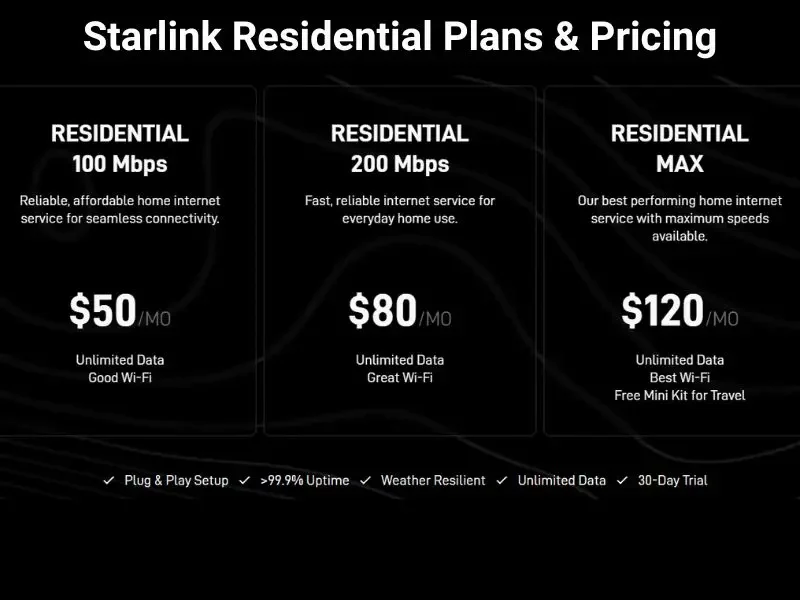
In an era where high-speed internet is crucial for work, entertainment, and staying connected, Starlink by SpaceX continues to revolutionize access, especially in rural and underserved areas. As of January 25th, 2026, Starlink offers three tailored residential plans designed to meet varying needs and budgets, starting from just $50 per month. 
starlink residential plans 2026.

These plans provide unlimited data, reliable connectivity via satellite technology, and easy setup without long-term contracts. Whether you’re streaming videos, working from home, or browsing casually, Starlink’s residential options ensure seamless performance with >99.9% uptime and weather-resilient service.

This article breaks down each plan in detail, including monthly costs, key features like speeds and Wi-Fi quality, and realistic expectations based on user experiences. We’ll explore the Residential 100 Mbps for budget-conscious users, the Residential 200 Mbps for everyday demands, and the Residential Max for top-tier performance. By the end, you’ll have a clear understanding of which plan suits your household, and will answer all your questions regarding Starlink residential plans and how much they cost per month as of Jan 25th 2026. All plans include a 30-day trial, plug-and-play installation, and no upfront hardware fees, making it easier than ever to get started.

Starlink Residential 100 Mbps Plan

The Starlink Residential 100 Mbps plan stands out as a reliable, affordable home internet service for seamless connectivity, priced at just $50 per month with unlimited data and good Wi-Fi capabilities. This entry-level option is ideal for individuals or small households who need dependable internet without breaking the bank, especially in areas where traditional broadband isn’t available.
 
With expected download speeds up to 100 Mbps, users can comfortably handle everyday tasks like web browsing, email, social media scrolling, and standard-definition streaming on platforms like Netflix or YouTube. Upload speeds typically range from 5-15 Mbps, sufficient for video calls or uploading photos. Latency averages 30-50 ms, which is great for general use but may feel slightly delayed for competitive online gaming. Based on user reviews from 2026, many report consistent performance during off-peak hours, with minimal outages thanks to Starlink’s satellite network advancements. However, in high-congestion areas, speeds might dip to 50-80 Mbps temporarily.
 
What users can expect includes easy setup: the kit arrives with a dish, router, and app-guided installation that takes about 30 minutes. The good Wi-Fi router covers up to 2,000 square feet, supporting 10-15 devices simultaneously without lag for basic activities. For families with light usage—think remote learning or casual streaming—this plan delivers value, often outperforming DSL or fixed wireless alternatives in rural spots. Pros include unlimited data (no caps or throttling), weather resilience (works in rain or snow), and a 30-day money-back guarantee. Cons? It’s not prioritized during peak times, so heavy users might notice slowdowns. Overall, if your needs are modest, this plan provides satisfying, cost-effective connectivity that enhances daily life without excess. Upgrading is simple if demands grow.
 
For those considering Starlink residential plans cost in 2026, this $50/mo option is a smart starting point. Users praise its affordability, with many noting improved reliability over previous years as the constellation expands.

Starlink Residential 200 Mbps Plan

The Starlink Residential 200 Mbps plan offers fast, reliable internet service for everyday home use, available at $80 per month with unlimited data and great Wi-Fi features. This mid-tier choice is perfect for growing families or moderate users who require more bandwidth than basic plans without the premium price tag.
 
Delivering download speeds up to 200 Mbps, this plan excels in handling multiple streams, such as 4K video on multiple devices, online schooling, and light work-from-home setups. Upload speeds hover around 10-20 Mbps, enabling smooth file sharing or video conferencing on Zoom or Teams. Latency remains low at 25-45 ms, making it suitable for casual gaming, video calls, and real-time applications. Recent 2026 user feedback highlights its deprioritized status—meaning it might slow to 100-150 Mbps during network congestion—but overall, it provides stable performance, especially in suburban or rural environments where alternatives lag.
 
Users can expect a hassle-free experience starting with the self-install kit, which includes an enhanced router for better coverage up to 3,000 square feet and support for 20+ devices. The great Wi-Fi ensures stronger signals throughout the home, reducing dead zones. Ideal for households streaming HD content, browsing intensively, or using smart home devices, this plan offers unlimited data freedom, eliminating worries about overage fees. Weather resilience keeps connections strong, with >99.9% uptime reported by most subscribers. Pros: Affordable upgrade from entry-level, easy app management for network monitoring, and compatibility with mesh extenders for larger homes. Potential drawbacks include occasional peak-hour throttling in busy cells, though Starlink’s expanding satellites mitigate this.
 
In terms of Starlink residential plans and how much they cost per month as of Jan 25th 2026, this $80 option strikes a balance, often described as “game-changing” for remote workers. If you’re upgrading from slower services, expect noticeable improvements in speed and reliability, with options for priority support add-ons at $20/mo.

Starlink Residential Max Plan

The Starlink Residential Max plan represents our best performing home internet service with maximum speeds available, costing $120 per month and including unlimited data, best Wi-Fi, and a free Mini Kit for Travel. This top-of-the-line option is tailored for power users, large families, or professionals demanding peak performance in any location.
 
Boasting download speeds up to 400+ Mbps in most areas, users enjoy lightning-fast downloads, ultra-HD streaming, and seamless multi-device usage. Upload speeds reach 15-30 Mbps, perfect for content creators uploading videos or backing up large files. Latency is impressively low at 20-40 ms, supporting competitive gaming, virtual reality, and high-stakes video calls. As a standard-priority plan, it avoids deprioritization, ensuring consistent speeds even during peak times. 2026 reviews emphasize its superiority in congested areas, with many users reporting real-world averages of 250-350 Mbps, far surpassing fiber in remote spots.
 
What users can expect begins with premium setup: the kit features an advanced router with best-in-class Wi-Fi, covering 4,000+ square feet and handling 30+ devices effortlessly. The free Mini Kit for Travel adds portability— a compact dish for on-the-go use in RVs, boats, or campsites, with discounted roaming plans starting at $30/mo in 150+ markets. This perk is invaluable for frequent travelers, allowing paused home service without penalties. Unlimited data means no limits on binge-watching, downloads, or cloud storage. Pros: Exceptional reliability with weather-proof tech, free equipment upgrades every two years, and 24/7 priority support. Minor cons include the higher cost, though it’s justified for heavy usage.
 
For anyone searching Starlink residential plans cost per month in 2026, this $120 plan delivers ultimate satisfaction, often hailed as “future-proof” internet. If your lifestyle involves intensive online activities, expect transformative connectivity that adapts to your needs, complete with easy integration for smart homes and IoT devices.

Connectivity News & Updates

A detailed article comparing ASTS against Starlink.

ASTS vs Starlink

When people hear “satellite internet,” they often assume all space-based...

Disclaimer: InstallersofStarlink.com is an independent business and has no affiliation or official connection with Starlink, SpaceX, or any of their subsidiaries or affiliates. We are not associated with, authorized, endorsed, or sponsored by these companies in any capacity. For official information, please visit the Starlink and SpaceX websites at www.starlink.com and www.spacex.com. The names “Starlink,” “SpaceX,” and any related trademarks, logos, or imagery are the exclusive property of their respective owners.